Postgrad Spain
Spain Student Visa: Requirements, Document Checklist + Common Mistakes
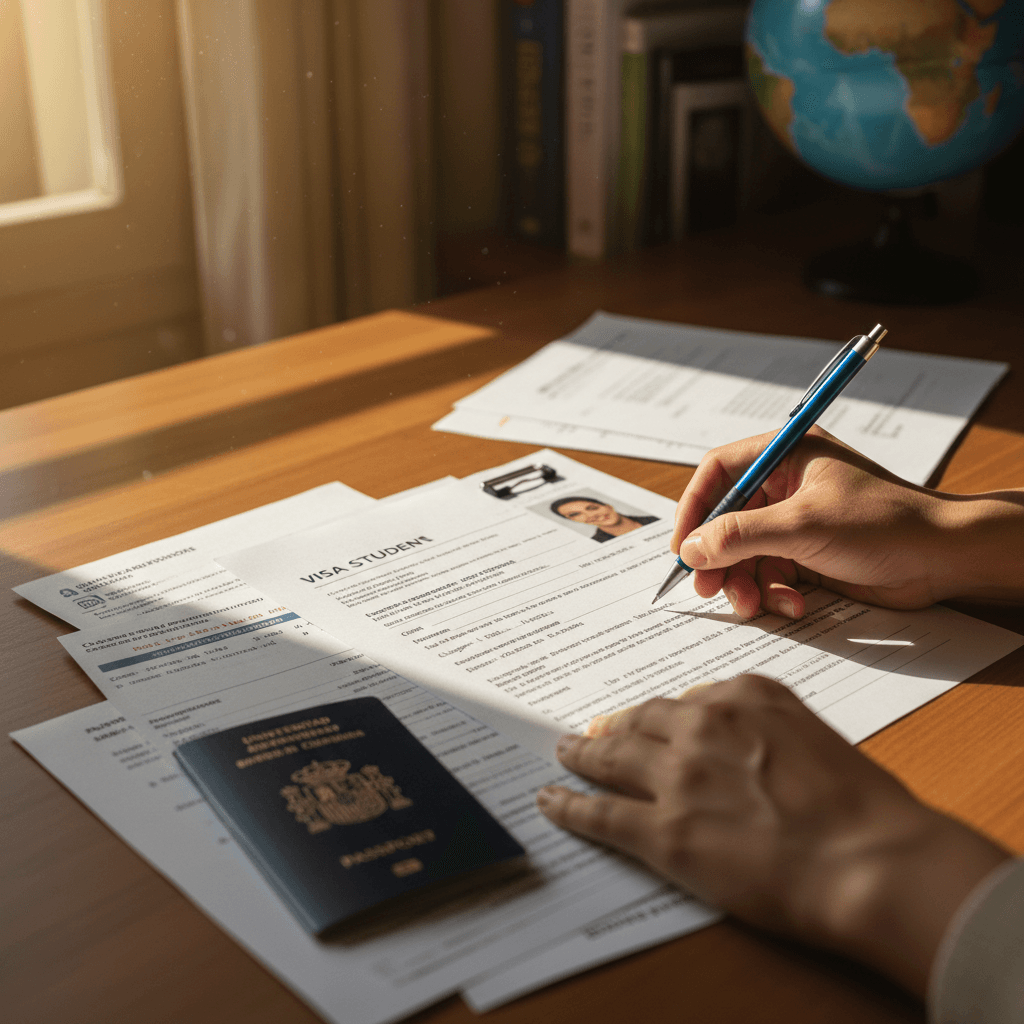
If you are planning to pursue a Master's, PhD, or post-doc program in Spain, the visa application process is one of the most critical steps you will face. Getting it right the first time can save you months of delays, and getting it wrong can mean missing your program start date entirely.
This guide breaks down the full process: what the "student visa" actually is under Spanish immigration law, every document you need, what consulates look for in your financial proof, and the most common reasons applications are rejected. Whether you are applying from Latin America, Sub-Saharan Africa, South Asia, or anywhere else outside the EU, this is the checklist you need.
Last updated: February 2026. All amounts and timelines reflect current Spanish consular requirements.
What Is the Estancia por Estudios? (It Is Not Technically a "Visa")
Before diving into the checklist, an important distinction: what most people call a "Spain student visa" is technically an estancia por estudios (stay for studies). Under Spanish immigration law, this is an authorization to stay in Spain for academic purposes rather than a standard visa or residency permit.
Why does this matter? The estancia por estudios:
- Is tied to your enrollment at a specific institution
- Must be renewed if your program exceeds one year
- Does not count toward permanent residency in most cases (although recent reforms are changing this)
- Allows limited work (up to 20 hours per week) with a separate authorization
You will still go through the "visa" application process at your Spanish consulate, and the documents required are essentially the same. But understanding the legal category helps you navigate renewals and future immigration steps correctly.
For the rest of this article, we will use "student visa" for readability, but know that the formal term is estancia por estudios.
Who Needs a Student Visa for Spain?
EU/EEA/Swiss citizens: You do not need a student visa. You can enroll and reside in Spain freely with just your national ID card. You may need to register with the local authorities (empadronamiento) and obtain a certificate of EU registration, but there is no visa application.
Non-EU citizens: You do need an estancia por estudios if your program lasts longer than 90 days. This applies to citizens of all non-EU countries, including those from Latin America, Africa, the Middle East, South Asia, China, Russia, the United States, Canada, and Australia.
If your program is shorter than 90 days and your nationality allows visa-free Schengen entry, you may study on a tourist entry. However, for any Master's or PhD, you will need the full estancia por estudios.
The Complete Document Checklist
Here is every document you need for a Spain student visa application in 2026. Requirements can vary slightly by consulate, so always confirm with your specific Spanish consulate, but this list covers the standard requirements across all jurisdictions.
- Valid passport — Must be valid for at least the entire duration of your intended stay. Most consulates prefer at least 6 months of validity beyond your program end date. Must have at least two blank pages.
- Completed visa application form (EX-00) — The standard Spanish national visa application form. Download from the consulate website or the Spanish Ministry of Foreign Affairs. Fill it out completely; do not leave fields blank (write "N/A" if a field does not apply).
- Two recent passport-sized photographs — Biometric format (white background, 35x45mm). Must be recent (taken within the last 6 months).
- Acceptance letter from a Spanish educational institution — Official letter from a recognized institution confirming your enrollment, the program name, duration, start and end dates, and whether the program is full-time. The institution must be accredited in Spain.
- Proof of financial means — You must demonstrate you can support yourself for the entire duration of your stay. The standard threshold is approximately IPREM 100% monthly, which for 2026 is approximately 600 EUR per month (or the full amount for your entire stay shown as a lump sum). Accepted proof includes:
- Personal bank statements (last 3-6 months)
- Scholarship or grant letter stating the amount covered
- Sponsor/guarantor letter with their bank statements
- Government-backed student loan documentation
- Health insurance — Private health insurance valid in Spain covering the full duration of your stay. This is one of the most scrutinized documents. Your policy must include:
- Full medical coverage (not just emergency coverage)
- No copayments (or minimal copayments depending on consulate)
- No deductibles (or very low deductibles)
- Repatriation coverage
- Coverage valid from your arrival date in Spain
- Criminal background check — Issued by the relevant authority in your country of residence (e.g., FBI for US, PCC for India, Certificado de Antecedentes for LatAm countries). Must be:
- Recent (issued within the last 3-6 months, depending on consulate)
- Apostilled (if your country is a signatory of the Hague Apostille Convention) or legalized (if not)
- Translated into Spanish by a sworn translator if not originally in Spanish
- Medical certificate — A certificate from a licensed physician stating that you do not suffer from any disease that poses a risk to public health in accordance with the International Health Regulations of 2005. Must be recent and may need to be apostilled/legalized and translated.
- Proof of accommodation — Evidence of where you will live during at least the first months of your stay. This can be:
- A rental contract or reservation
- University residence confirmation
- A letter of invitation from a host (with their ID and proof of their residence)
- Hotel booking for initial weeks (with evidence that you are searching for permanent housing)
- Visa fee payment — Varies by consulate and nationality. Typically between 60-80 EUR. Check your consulate for the exact amount and accepted payment methods.
Financial Proof: What Consulates Actually Accept
The financial requirement is where many applications stumble. Here is what works and what does not.
Bank Statements That Work
Consulates want to see consistent financial stability, not just a snapshot of your balance on one day. Provide bank statements covering the last 3 to 6 months that show:
- A stable or growing balance
- Regular income deposits (salary, transfers from family, etc.)
- A final balance that covers your full stay (approximately 600 EUR x number of months)
For a one-year Master's program, this means showing at least 7,200 EUR (or equivalent in your local currency) available. Some consulates may ask for more.
Scholarship and Grant Letters
If you have a scholarship, the award letter should specify the total amount or monthly stipend, whether it covers tuition and/or living expenses, the duration of funding, and that the funds are accessible from Spain. A scholarship above the IPREM threshold can substitute for personal bank statements.
Sponsor Letters
If a family member or sponsor is funding your studies, you need: a signed letter stating their financial commitment, the sponsor's bank statements (last 3-6 months), proof of the relationship (if family), and notarization where required by your consulate.
What Gets Rejected
- Sudden large deposits right before the application — consulates recognize this pattern
- Cryptocurrency holdings or investment portfolios (consulates want liquid, accessible bank funds)
- Accounts opened recently just for the visa application
- Letters of support without accompanying bank proof
The Appointment and Application Process
Step 1: Book Your Consulate Appointment
Spanish consulate appointment availability varies dramatically by country. In some countries (India, Morocco, Colombia), wait times for an appointment slot can be 4 to 8 weeks. In others, you can get an appointment within days.
Start early. As soon as you receive your acceptance letter, book your consulate appointment. Do not wait until all your documents are ready — many consulates allow booking while you gather documents, and you can always reschedule.
Step 2: Submit Your Application
On your appointment day, bring all original documents plus one photocopy of each (some consulates require two copies). The appointment is primarily a document submission, not an interview, though consular officers may ask questions.
Step 3: Wait for Processing
Standard processing time is 1 to 3 months. You typically will not receive updates during processing. Some consulates allow online status checks, but many provide no information until the decision is made.
Step 4: Pick Up Your Visa
Once approved, you will collect your passport with the visa sticker. Your visa shows a validity window for entering Spain — typically 90 days, though you cannot arrive before the program start date.
Common Rejection Reasons and How to Avoid Them
Understanding why applications get rejected helps you avoid these pitfalls.
1. Insufficient or Non-Compliant Health Insurance
This is the most common rejection reason. Your insurance must meet Spain's specific requirements:
- Full coverage, not just emergency or travel insurance
- No copayments or very low copayments (varies by consulate)
- No deductibles or very low deductibles
- Must cover the full duration of your stay, starting from your arrival date
- Must include repatriation
How to avoid it: Purchase insurance from a provider that specifically offers Spain student visa-compliant policies. Many international student insurance companies (Adeslas, ASISA, Sanitas) offer packages designed for this. If you plan to read more about compliant options, see our guide on health insurance for your student visa.
2. Financial Statements Showing Sudden Large Deposits
Consulates look for financial patterns, not just a balance. If your account shows a large transfer days before the application with minimal activity before that, it raises a red flag.
How to avoid it: Maintain consistent balances over 3-6 months. If you receive a legitimate lump sum (inheritance, property sale, scholarship disbursement), have documentation ready to explain its source.
3. Missing Apostilles or Legalizations
Your criminal background check and other official documents must be apostilled (for Hague Convention countries) or legalized through the appropriate diplomatic channels (for non-Hague countries). A document without the correct authentication is considered invalid.
How to avoid it: Check whether your country is part of the Hague Apostille Convention. If so, get an apostille from your government's designated authority. If not, your documents will need to be legalized through your country's Ministry of Foreign Affairs and then authenticated by the Spanish consulate. This can add weeks to your preparation time.
4. Incorrect or Missing Translations
All documents not in Spanish must be translated by a sworn translator (traductor jurado) recognized by the Spanish Ministry of Foreign Affairs. A regular translation — even a certified one from your country — may not be accepted.
How to avoid it: Use a sworn translator listed on the Spanish Ministry of Foreign Affairs registry. If you are outside Spain, some consulates have lists of approved translators in your country.
5. Expired Criminal Background Check
Background checks have a limited validity period, usually 3 to 6 months from the date of issue. If your processing timeline runs long, the document may expire before your application is decided.
How to avoid it: Time your background check to be as recent as possible when you submit. If your consulate appointment is months away, wait to request the background check until closer to your submission date — but factor in processing times for the check itself.
6. Incomplete Application Form
Small mistakes on the EX-00 form — blank fields, missing signatures, incorrect dates — can cause delays or rejection.
How to avoid it: Fill out every field. Use "N/A" for non-applicable fields. Double-check dates, passport numbers, and program details. Have someone review your form before submission.
After Approval: Your Next Steps in Spain
Once you have your visa and arrive in Spain, the process continues.
The 30-Day Rule: Apply for Your TIE
Within 30 days of arriving in Spain, you must apply for your TIE (Tarjeta de Identidad de Extranjero) — your foreigner identity card that replaces the visa sticker in your passport. You will need the EX-17 form, your passport with visa, proof of enrollment, proof of address (empadronamiento), valid health insurance, photos, and fee payment (Tasa 790, code 012).
The TIE appointment is booked through the Sede Electronica and can be competitive in Madrid and Barcelona. Book it as soon as you arrive.
Empadronamiento (Municipal Registration)
You also need to register your address at your local town hall (ayuntamiento). The empadronamiento is required for the TIE, bank accounts, and many other administrative tasks. See our complete guide to empadronamiento and NIE/TIE for the full process.
Renewal: If Your Program Exceeds One Year
If your Master's or PhD program runs longer than the initial authorization period (typically one year), you will need to renew your estancia por estudios before it expires.
Begin the renewal process at least 60 days before your authorization expires. You submit at the Oficina de Extranjeria in Spain, and you can legally remain while the renewal is processing.
You will need updated proof of enrollment and academic progress, fresh financial proof, valid insurance, and current accommodation proof. Academic progress matters — if you have failed most courses or not been attending, the renewal may be denied. Immigration authorities verify with your institution.
Your Preparation Timeline
For a Master's program starting in September 2026, here is a recommended timeline:
When | Action
January-February | Research programs, begin applications
March-April | Receive acceptance letters, book consulate appointment
April | Request criminal background check, arrange apostille
May | Gather financial proof, purchase health insurance
May-June | Get medical certificate, arrange translations
June-July | Attend consulate appointment, submit application
July-September | Processing period (1-3 months)
September | Collect visa, travel to Spain
September (upon arrival) | Book TIE appointment, complete empadronamiento
This timeline assumes a standard processing flow. Some countries may require more time for apostilles, background checks, or consulate appointments. Start as early as possible.
Conclusion
The Spain student visa process is detailed, but it is navigable with the right preparation. The key is starting early, understanding exactly what each document needs to look like, and avoiding the common mistakes that lead to rejections — particularly around insurance coverage and financial proof.
Every consulate has subtle differences in what they require and how strictly they interpret the rules. If your situation involves complexities (multiple nationalities, gaps in bank statements, employer-sponsored study), getting your documents reviewed before submission can prevent costly delays.
If you are preparing your application and want to make sure everything meets your consulate's specific requirements, we offer a complete visa document review service that covers every item on this checklist plus a personalized appointment strategy for your country.
For a broader view of the full process of moving to Spain as a student, including housing, cost of living, and settling in, explore our companion guides.