Postgrad Spain
University of Valencia (UV) Student Guide
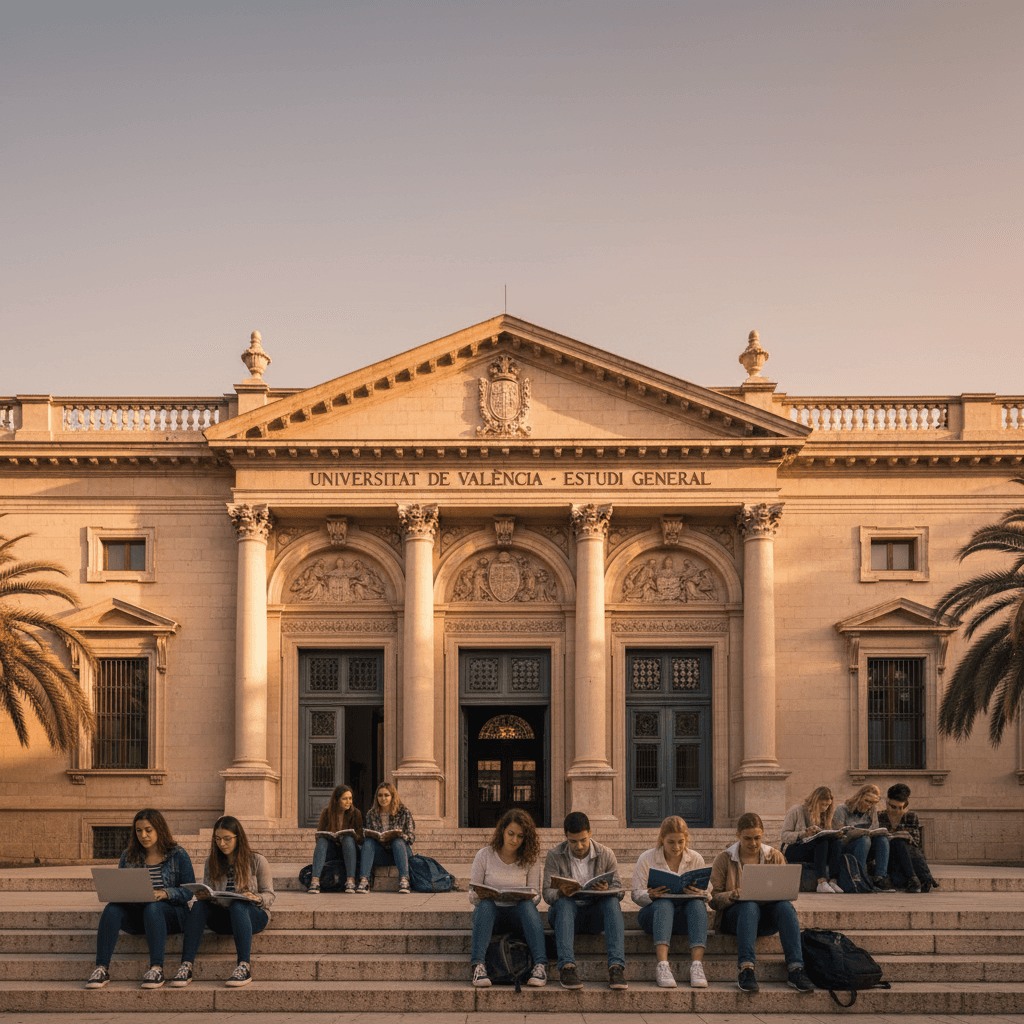
The Universitat de Valencia (UV), founded in 1499, is one of Spain's oldest and most prestigious universities. With over five centuries of history, it has grown into a comprehensive public university covering humanities, sciences, social sciences, health, and education — making it one of the most diverse universities in the country.
For international postgraduate students, UV offers breadth that few Spanish universities can match: from experimental physics and biomedical research to translation studies and international economics, all within a city that makes student life genuinely enjoyable.
This guide covers everything you need to know about studying at UV — admissions, campuses, popular programs, student services, and practical day-to-day information.
University Overview
Key Facts
- Full name: Universitat de Valencia — Estudi General
- Founded: 1499
- Students: Approximately 55,000 (including around 7,000 international students)
- Campuses: Blasco Ibanez (main), Burjassot-Paterna (sciences), Tarongers (social sciences and law), La Nau (historic center)
- Rankings: Top 5 in Spain overall, Top 200 globally (QS), Top 100 in Europe for several fields including physics, linguistics, and geography
- Language of instruction: Spanish and Valencian (majority), English (growing number of master's programs)
Academic Structure
UV is organized into 18 faculties and several university research structures:
Humanities and Education:
- Facultad de Filologia, Traduccion y Comunicacion (Philology, Translation, Communication)
- Facultad de Filosofia y Ciencias de la Educacion (Philosophy and Education)
- Facultad de Geografia e Historia (Geography and History)
Sciences:
- Facultad de Fisica (Physics)
- Facultad de Quimica (Chemistry)
- Facultad de Ciencias Biologicas (Biological Sciences)
- Facultad de Matematicas (Mathematics)
- Facultad de Farmacia (Pharmacy)
Social Sciences and Law:
- Facultad de Derecho (Law)
- Facultad de Economia (Economics)
- Facultad de Ciencias Sociales (Social Sciences)
Health:
- Facultad de Medicina y Odontologia (Medicine and Dentistry)
- Facultad de Enfermeria y Podologia (Nursing and Podiatry)
- Facultad de Psicologia (Psychology)
- Facultad de Fisioterapia (Physiotherapy)
Admissions for International Students
Master's Programs
UV offers over 120 official master's programs — one of the largest selections in Spain.
Application timeline:
- Pre-enrollment period: Typically March-June (first round), July-September (second round)
- Key dates: Published annually on the UV admissions website (www.uv.es/master)
- Recommendation: Apply in the first round for the widest selection of places
Requirements:
- Completed bachelor's degree (or equivalent foreign degree)
- Academic transcript with grades
- CV
- Language certificate: Spanish B1-B2 for Spanish-taught programs, English B2 for English-taught programs
- Specific prerequisites vary by program (e.g., health programs may require specific undergraduate backgrounds)
- Some programs require a motivation letter, letters of recommendation, or interview
Application process:
- Access the online pre-enrollment system at www.uv.es/master
- Register and select your preferred program(s)
- Upload required documentation
- Pay the application fee (approximately EUR 30-50)
- Admissions committee evaluates applications and publishes results
- Accepted students complete enrollment and pay tuition within the designated period
PhD Programs
UV's Doctoral School manages PhD admissions. The process requires:
- An accepted master's degree (or equivalent)
- A research proposal aligned with a UV research group
- A thesis supervisor willing to direct your work
Contact potential supervisors before applying. Browse UV's research groups at www.uv.es/investigacion to find matches with your interests.
Tuition Fees
UV tuition for official master's programs (2025-2026 reference):
- EU residents: EUR 1,200-2,800 per year (depending on program and credit count)
- Non-EU residents: EUR 2,400-7,000 per year
- PhD programs: EUR 300-600 per year
- University-specific programs (titulos propios): Variable, typically EUR 1,500-8,000 per year
Campuses
Unlike UPV's single large campus, UV is distributed across several locations in Valencia and the metropolitan area.
Blasco Ibanez Campus
The largest and most central campus, located along the Avenida Blasco Ibanez near the beach.
- Faculties: Medicine, Psychology, Nursing, Physiotherapy, Geography and History, Philology, Philosophy and Education
- Getting there: Metro lines 5, 7 (Facultats station); bus lines 10, 12, 30, 31, 32, 41, 71, 81; tram line 4; Valenbisi stations throughout
- Character: Urban campus integrated into the city, surrounded by student-friendly bars, cafes, and shops
- Key facilities: Humanities library, Medical library, sports center, multiple cafeterias
Tarongers Campus
The social sciences campus, adjacent to the UPV campus in the northeastern part of the city.
- Faculties: Law, Economics, Social Sciences
- Getting there: Metro line 4 (Tarongers station); bus lines 18, 29, 30, 41; Valenbisi
- Character: Modern buildings, shared area with UPV, strong academic atmosphere
- Key facilities: Social sciences library, moot court, computing labs, student cafeteria
Burjassot-Paterna Campus
The science campus, located about 8 kilometers northwest of the city center in the municipalities of Burjassot and Paterna.
- Faculties: Physics, Chemistry, Biological Sciences, Mathematics, Pharmacy
- Getting there: Metro line 1 (Burjassot station, 20 minutes from city center); bus; car
- Character: Suburban campus with large facilities, research labs, and green space. Quieter than the central campuses.
- Key facilities: Science library, advanced research laboratories, botanical collections, cafeteria
- Note: The Paterna Science Park (Parc Cientific) is adjacent, hosting major research institutes including IFIC (nuclear and particle physics) and IFIMED (medical physics)
La Nau (Historic Center)
The original university building, dating to the 15th century. Located in the heart of Valencia's old town.
- Address: Carrer de la Universitat, 2
- Function: Cultural center, exhibition space, administrative offices, and the university's main ceremonial hall
- Public access: Free exhibitions and cultural events year-round
- Historical note: La Nau houses one of the most important university library collections in Spain, including medieval manuscripts
Popular Master's Programs for International Students
Sciences
- Master in Advanced Physics — Access to world-class research at IFIC (Institute of Corpuscular Physics). Strong connections with CERN. Partly taught in English.
- Master in Biodiversity — Leverages Valencia's unique ecosystems (Albufera, Mediterranean coast, mountain ranges). Field-based research opportunities.
- Master in Chemistry — Specializations in organic, analytical, and materials chemistry. Well-equipped labs.
- Master in Biomedical Research — Partnerships with Hospital Clinico Universitario and INCLIVA health research institute.
Humanities and Social Sciences
- Master in Translation and Intercultural Mediation — One of UV's strongest programs. Covers professional translation, interpreting, and cultural mediation. Multiple language combinations.
- Master in International Economics — Focuses on trade, development, and the European economic framework. Strong European orientation.
- Master in Spanish as a Foreign Language — Ideal for those who want to teach Spanish internationally. Combines linguistics, pedagogy, and cultural studies.
- Master in Cultural Heritage and Museums — Leverages Valencia's rich historical and cultural assets. Practical placements at local museums and heritage sites.
Health Sciences
- Master in Public Health — Combines epidemiology, health policy, and population health management. Partnerships with Valencian public health agencies.
- Master in Clinical Psychology — Research-focused program with clinical practicum at university-affiliated hospitals.
- Master in Neurosciences — Interdisciplinary program crossing psychology, biology, and medicine.
Law and Business
- Master in International Business Law — Covers EU law, international trade law, and dispute resolution.
- Master in Corporate Law and Governance — Practical orientation with ties to Valencia's business community.
Education
- Master in Secondary Education Teaching (Master del Profesorado) — Required qualification for teaching in Spanish secondary schools. Available in multiple specializations.
- Master in Educational Research — Focuses on educational policy, methodology, and assessment.
Student Services
International Relations Service (SRI)
- Location: Blasco Ibanez campus, Edificio de Servicios (next to the Humanities library)
- Services: Visa support letters, academic recognition of foreign degrees, exchange programs, welcome program for international students
- Contact: relacions.internacionals@uv.es
- Hours: Monday-Friday 09:00-14:00
Academic Support
- SADE (Servei d'Assessorament i Dinamitzacio Educativa): Academic counseling, study skills workshops, and educational support. Free for enrolled students.
- Tutorial system: Each master's program assigns academic coordinators who can guide you through the curriculum, thesis options, and career paths.
- Centre d'Idiomes (CIL): Language center offering Spanish courses for internationals, DELE preparation, English certification, and other languages. Fee-based but discounted for UV students.
Career Services
- ADEIT (Fundacion Universidad-Empresa): Connects UV students with internships and job opportunities. Organizes career fairs, company visits, and professional development workshops.
- UV Employment Portal: Online platform with job and internship listings from companies actively recruiting UV graduates.
- Entrepreneurship support: UV participates in StartUpV and has connections with the local startup ecosystem through its business incubator.
Health and Wellbeing
- Unitat d'Igualtat: Equality unit offering support for gender-based issues, diversity, and inclusion.
- Psychological support: Confidential counseling available through student services.
- University sports service: Facilities on the Blasco Ibanez and Tarongers campuses. Swimming pool, gym, tennis, padel, and organized leagues. EUR 50-80 per semester.
Libraries
UV's library system is extensive:
- Biblioteca d'Humanitats Joan Regla: Main humanities library on Blasco Ibanez campus
- Biblioteca de Ciencies Socials Gregori Maians: Social sciences library on Tarongers campus
- Biblioteca de Ciencies Eduard Bosca: Science library on Burjassot campus
- Biblioteca Historica: Historic library at La Nau with rare books and manuscripts
- Total resources: Over 2 million volumes, extensive digital collections, inter-library loan across all Spanish universities
All libraries offer study spaces, group rooms, computers, and printing. Extended hours during exam periods.
Nearby Neighborhoods
Blasco Ibanez Area
The streets surrounding the main campus form one of Valencia's densest student zones.
- Rent: EUR 280-420 for a room in a shared apartment
- Character: Student-heavy, urban, lively. Bars, cafes, and kebab shops on every corner.
- Commute to campus: 5-10 minutes walking
- Social life: Active nightlife, student bars, and affordable dining. Calle Polo de Bernabe and surrounding streets are the social hub.
Benimaclet
A 15-minute walk north of the Blasco Ibanez campus (and also close to UPV), Benimaclet attracts students from both universities.
- Rent: EUR 250-380 for a room in a shared apartment
- Character: Village feel with student energy. Central plaza, local market, arts scene.
- Commute to campus: 15-20 minutes walking, 7 minutes by bike
- Why choose it: Better community feel than Blasco Ibanez, slightly cheaper, and access to both UV and UPV
El Cabanyal
The historic fishermen's neighborhood near the beach, east of the Blasco Ibanez campus.
- Rent: EUR 250-380 for a room in a shared apartment
- Character: Rapidly gentrifying but still authentic. Art galleries, independent restaurants, traditional architecture with colorful ceramic facades.
- Commute to campus: 15-20 minutes by bike, 20-25 minutes walking
- Advantage: Beach access in 5 minutes. One of Valencia's most characterful neighborhoods.
Russafa
South of the city center, Russafa is Valencia's trendiest neighborhood. Farther from the Blasco Ibanez campus but well-connected by bus and metro.
- Rent: EUR 300-450 for a room in a shared apartment
- Character: Cosmopolitan, foodie, artistic. The best restaurants, specialty coffee, galleries, and nightlife in Valencia.
- Commute to campus: 20-30 minutes by bus or bike
- Why choose it: If social and cultural life matter more to you than campus proximity
Algiros (for Tarongers Campus students)
If your program is on the Tarongers campus, Algiros is the closest residential neighborhood.
- Rent: EUR 250-400 for a room in a shared apartment
- Character: Residential, quiet, practical
- Commute to Tarongers: 5-15 minutes walking
Research at UV
UV is one of Spain's top research universities, particularly strong in several fields.
Research Strengths
- Physics: IFIC (Institute of Corpuscular Physics), a joint CSIC-UV center, participates in experiments at CERN, including the ATLAS detector at the Large Hadron Collider. UV physicists contributed to the Higgs boson discovery.
- Biotechnology and biomedicine: INCLIVA health research institute is affiliated with UV and Hospital Clinico Universitario. Active research in oncology, cardiovascular disease, and rare diseases.
- Environmental science: Research on Mediterranean ecosystems, climate change impacts on the Albufera wetland, and sustainable agriculture.
- Linguistics and translation: UV is a leading center for translation studies and applied linguistics in Spain.
- Astronomy: UV operates the Observatorio Astronomico and participates in international telescope networks.
Parc Cientific de la Universitat de Valencia
Located adjacent to the Burjassot campus, the Science Park hosts:
- Research institutes (IFIC, IFIMED, ICMol)
- Technology transfer offices
- Startup incubators
- Shared advanced equipment facilities (electron microscopy, NMR, mass spectrometry)
Master's students in research-track programs can access these facilities for their thesis work.
UV vs. UPV: How to Choose
Students often ask which university to choose. The answer depends on your field and preferences:
Factor | UV | UPV
Strengths | Humanities, sciences, health, law, social sciences | Engineering, architecture, design, technology
Campus | Distributed across city | Single large campus
Size | ~55,000 students | ~36,000 students
Feel | Urban, integrated into city life | Self-contained campus community
Research | Strong in fundamental sciences, humanities | Strong in applied sciences, innovation
International mix | ~7,000 international students | ~5,000 international students
English programs | Growing, especially in sciences | Growing, especially in engineering
Startup culture | Present but less dominant | Very strong (Marina de Empresas, Lanzadera)
Many students in Valencia interact with both universities socially, regardless of where they are enrolled. The campuses are adjacent, neighborhoods overlap, and student life is shared.
Daily Life as a UV Student
A Typical Day (Blasco Ibanez Campus)
- 08:30-09:00: Coffee at a bar on Blasco Ibanez (EUR 1.30 cafe con leche)
- 09:00-13:00: Morning lecture block
- 13:00-14:30: Lunch — campus cafeteria (EUR 5-7 menu del dia) or one of the many restaurants on surrounding streets
- 14:30-17:00: Library study time or seminar
- 17:00-18:30: Language class at CIL, or sports at the university gym
- 18:30-20:00: Free time — walk to the beach (15 minutes), coffee with classmates, or group project work
- 20:30+: Dinner (late, as is Spanish custom), intercambio at a bar in El Carmen, or studying at home
Campus Culture
UV has a different campus culture from UPV. Because UV's facilities are integrated into the city rather than isolated on a single campus, the boundary between university life and city life is blurred. Students mix with the general population in cafes, bars, and public spaces.
Key aspects:
- La Nau cultural programming: Free exhibitions, lectures, and concerts at the historic center building
- Student associations: Active in politics, culture, sports, and volunteer work
- Falla universitaria: UV participates in the Fallas festival with its own falla
- Academic traditions: UV maintains ceremonial traditions dating back centuries, including the opening of the academic year at La Nau
Tips for International Students at UV
- Choose your campus neighborhood wisely. Unlike a single-campus university, your daily experience at UV depends heavily on which campus your program is on. Visit your campus before signing a lease.
- Register for Spanish courses at CIL early. The Centre d'Idiomes fills up quickly, especially at the beginning of each semester. Even if your program is in English, basic Spanish will transform your experience.
- Use the SADE academic support service. If you are struggling with coursework, language barriers, or adapting to the Spanish academic system, SADE is there to help. Do not wait until it becomes a crisis.
- Attend La Nau events. The cultural programming at the historic university building is free and excellent. It also connects you with people from across all UV faculties, not just your own program.
- Explore the Burjassot campus if you are in sciences. Even if your classes are elsewhere, the Parc Cientific and the science facilities are worth visiting for research connections and thesis opportunities.
- Get the university sports membership. At EUR 50-80 per semester, it is exceptional value and provides a social environment outside your academic program.
- Connect with both UV and UPV student networks. The ESN chapters at both universities organize events that are open to students from either institution. Double your social opportunities.
Related Resources
- Polytechnic University of Valencia (UPV) Student Guide — The comprehensive guide to Valencia's other major university
- Complete Guide to Studying in Valencia as an International Student — Everything about studying in Valencia
- Get in touch — We help international students navigate UV admissions and relocation